
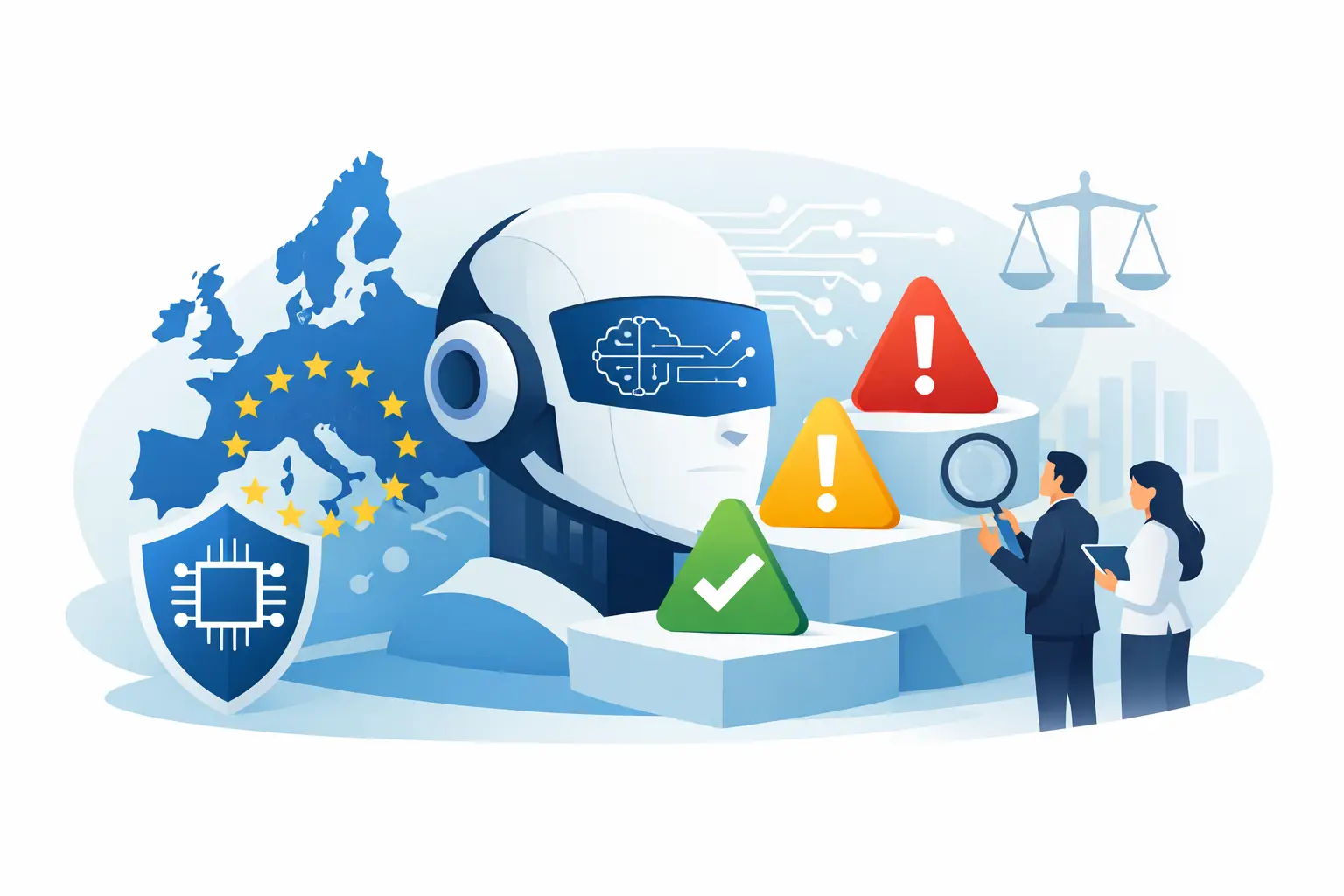
The EU AI Act classifies AI systems into four risk tiers: prohibited practices, which are banned outright; high-risk systems, which carry the heaviest compliance obligations; limited-risk systems, which trigger transparency duties; and minimal-risk systems, which face no material obligations under the core framework. If your AI inventory still has a column marked “risk level” with no agreed method behind it, the classification problem is already operational, not theoretical. For compliance, legal, and risk teams, classification is the point where abstract regulation turns into obligations, evidence, ownership, and board exposure.
The common mistake is treating classification as a one-off legal label. It is not. Under the Act, classification determines whether a system is prohibited, high-risk, subject to transparency duties, or largely outside the main compliance burden. Get that decision wrong and everything downstream starts to fail – conformity work, supplier due diligence, documentation, monitoring, and internal reporting.
What the EU AI Act risk classification actually does
The Act uses a tiered model to regulate AI systems according to their risk profile. In practice, that means the compliance load is not evenly distributed. Some uses are banned outright. Some trigger extensive controls. Others only require transparency. Many will sit in the minimal-risk category and face no material obligations under the core framework.
That sounds simple until you apply it to real estates of AI tools, embedded features, third-party systems, and internal models. Classification is not about whether AI feels “serious”. It is about whether the system falls within specific legal definitions and listed use cases. A chatbot used for internal IT support is not assessed in the same way as a CV screening engine or a credit decision model, even if both rely on similar underlying techniques.
This is why spreadsheet-based governance quickly breaks down. The legal trigger is tied to intended purpose, deployment context, affected persons, and in some cases whether the tool is a safety component of a regulated product. You need a repeatable method, not a rough risk rating.
The four levels in EU AI Act risk classification
Prohibited AI practices
At the top of the scale are practices the Act prohibits because the risk is considered unacceptable. These include certain forms of manipulative or exploitative AI, some social scoring practices, and tightly restricted biometric uses. The key point for governance teams is that prohibition is not a higher compliance tier. It is a stop signal.
If a use case falls here, the answer is not “add more controls”. The answer is to halt procurement, deployment, or continued use unless a narrow exception clearly applies. That requires escalation pathways and legal review, because business owners often assume every AI risk can be mitigated operationally. Under this category, some cannot.
High-risk AI systems
High-risk systems carry the heaviest compliance burden and will absorb most governance effort. This category includes AI used in specified areas such as employment, education, access to essential services, law enforcement, migration, and administration of justice, as well as AI that forms a safety component of certain regulated products.
For in-scope systems, the obligations are substantial. Providers are expected to maintain risk management processes, data governance measures, technical documentation, logging, human oversight, accuracy and cybersecurity controls, and post-market monitoring. Deployers also have specific duties, particularly around use in accordance with instructions, oversight, input data relevance, and monitoring.
This is where classification must be precise. Teams often overfocus on model sophistication and underfocus on use context. A relatively simple model used to rank job applicants can create a high-risk position. A far more technically complex generative tool may not.
Limited-risk systems
This category is mainly about transparency. Typical examples include AI systems that interact directly with natural persons or generate synthetic content in ways that could mislead if undisclosed. The burden is lighter than for high-risk systems, but it is still a compliance obligation.
For many organisations, limited-risk systems are the hidden volume problem. They may not require full conformity processes, but they still need inventory visibility, clear ownership, approved notices, and monitoring to make sure transparency measures are actually applied in production.
Minimal-risk systems
Minimal-risk systems sit largely outside the main prescriptive obligations. This does not mean no governance is needed. It means the Act does not impose the same structured control burden on those uses.
In practice, many internal productivity tools, low-impact assistive systems, and non-sensitive automation features may land here. But “minimal-risk” should never be treated as “ignore”. Procurement, security review, privacy analysis, and internal policy controls may still apply, especially where confidential data, employee monitoring, or customer-facing outputs are involved.
Why classification is harder than it looks
The hard part is not memorising the categories. It is applying them consistently across a mixed estate of internally built tools, supplier products, model features, and evolving use cases.
The first challenge is identifying the AI system itself. Many organisations are not classifying systems. They are classifying vendors, products, or business projects. That is too blunt. A single platform may contain multiple AI functions with different intended purposes and different legal consequences.
The second challenge is role-mapping. Under the Act, obligations vary depending on whether your organisation acts as provider, deployer, importer, or distributor. That distinction matters. If you materially modify a third-party system, rebrand it, or place it on the market under your own name, your compliance position may change. Classification without role analysis is incomplete.
The third challenge is lifecycle drift. A system initially deployed for a low-impact internal purpose can move into a high-risk setting through scope expansion, integration, or new decision use. This is why point-in-time assessment is not enough. Classification needs review triggers tied to change management.
A practical method for EU AI Act risk classification
For most organisations, the cleanest approach is to start with the inventory, not the policy. Build a record of each AI system, its owner, vendor or development origin, intended purpose, user group, affected individuals, inputs, outputs, deployment geography, and whether it supports or influences decisions in regulated contexts.
From there, apply a structured legal triage. First ask whether the use case could fall within a prohibited practice. If yes, escalate immediately. If no, test whether the system is a high-risk AI system either because it is embedded in a regulated product regime or because its intended purpose matches an Annex III use case. If neither applies, assess whether transparency obligations are triggered. If not, record the rationale for minimal-risk treatment.
That rationale matters. Auditors, regulators, and internal assurance teams do not just want the label. They want to see how the label was reached, who approved it, what evidence was reviewed, and when reassessment is due.
A defensible workflow usually includes legal interpretation notes, business owner attestations, supplier documentation, procurement records, technical context, and control assignments. This is where platforms built for AI governance have a practical advantage over generic GRC tools or spreadsheets. The issue is not storing a risk score. It is maintaining a traceable decision model that stands up to audit.
High-risk classification is only the start
A high-risk outcome often creates a false sense of completion. Teams think the main task was identifying the system. In reality, that is where delivery begins.
Once a system is classified as high-risk, the organisation needs to translate legal duties into operational controls. That means assigning accountability, gathering technical documentation, testing data and model governance, confirming logging, defining human oversight, checking instructions for use, and setting monitoring and incident processes. If the tool comes from a supplier, contract and assurance work become critical because the provider may hold key evidence you need but do not control.
This is also where ISO/IEC 42001 alignment becomes commercially useful. The Act tells you what obligations exist for specific AI systems. ISO 42001 helps structure the management system around them. Used properly, the two frameworks reduce duplication rather than adding more paperwork.
What mature teams do differently
The strongest compliance teams do not ask, “What category is this AI tool?” in isolation. They ask five linked questions: what is the system, what is its intended purpose, what role do we play, which legal triggers apply, and what evidence supports the answer.
They also avoid two expensive errors. The first is overclassification, where everything is treated as high-risk and the programme becomes impossible to run. The second is optimistic underclassification, often driven by procurement pressure or vendor marketing. Neither is sustainable.
A proportionate model is the goal. That means legal precision at intake, documented review points when systems change, and clear ownership for ongoing monitoring. It also means choosing governance infrastructure that can produce regulator-ready records without turning implementation into a year-long software project. That is the gap many mid-market and compliance-led organisations are now trying to close.
If your AI estate is growing faster than your ability to classify it, start with defensibility rather than volume. One well-structured classification process will do more for regulatory readiness than another policy document no one can operationalise.